A buyer walks a canal-front lot in Boca Harbour and hears the phrase every listing repeats: no HOA fee. No monthly dues, no architectural review board, no committee deciding what color you can paint your dock box. For a buyer coming from a country club community with a $1,500-a-month association bill, that sounds like pure upside.
Then they ask who's responsible if the seawall two doors down starts leaning into the canal. The answer is nobody. That's the part the listing sheet leaves out.
One Name, Two Rulebooks
Boca Harbour sits along the Intracoastal Waterway between Bel Marra and Boca Bay Colony, and it's one of the older waterfront enclaves in East Boca. Homes here started going up in the 1960s, which gives the streets a genuine "Old Florida" character even as newer construction fills in the gaps. There are 325 custom-built estate homes total, and at the center of the community sits a private island in the middle of the Intracoastal with 45 homes of its own, known locally as Boca Harbour Island.
Here's what most buyers don't realize until they're deep in a contract: the mainland section and the island section aren't governed the same way. The mainland canal lots have no mandatory association at all. What exists instead is the Boca Harbour Residents Club, a voluntary group that runs on tiered annual contributions of $65, $125, $250, or $500. Every membership tier currently gets the same access to community events and resources, and the payments are yearly rather than auto-recurring. It's a social organization, not a governing body. It can't compel a neighbor to fix anything.
The island tells a different story. Public HOA directories list a separate Boca Harbour Harbour Island Homeowners Association, distinct from the mainland's residents club. That distinction rarely makes it into a listing description, but it matters. If you're comparing a mainland canal lot to an island lot, you're not comparing two houses under one set of rules. You're comparing two different governance structures that happen to share a neighborhood name.
What "No HOA" Actually Buys You
On the mainland side, no mandatory HOA means real freedom. You can renovate, dock, and rebuild without an architectural review board weighing in on your plans, which helps explain why the streets mix 1960s ranch homes with brand-new construction rather than one uniform style. Nobody is going to fine you for a boat lift they don't like the look of.
The trade-off shows up in shared infrastructure. Nearby Boca Marina Yacht Club runs the opposite model: its HOA maintains every dock in the community, which creates uniformity and specifically removes the risk of one owner's neglected dock or seawall affecting the property next to it. Boca Harbour doesn't have that mechanism. If a seawall on an adjacent lot is failing, there's no association board to send a notice, levy an assessment, or force a repair timeline. It's a conversation between neighbors, or it's nothing at all.
Ask your agent to pull the seawall permit history on the property you're touring and the two lots next to it, not just the one you're buying.
That single question tells you more about your actual exposure than any listing photo of a dock.
The Seawall Math Nobody Puts in the Listing
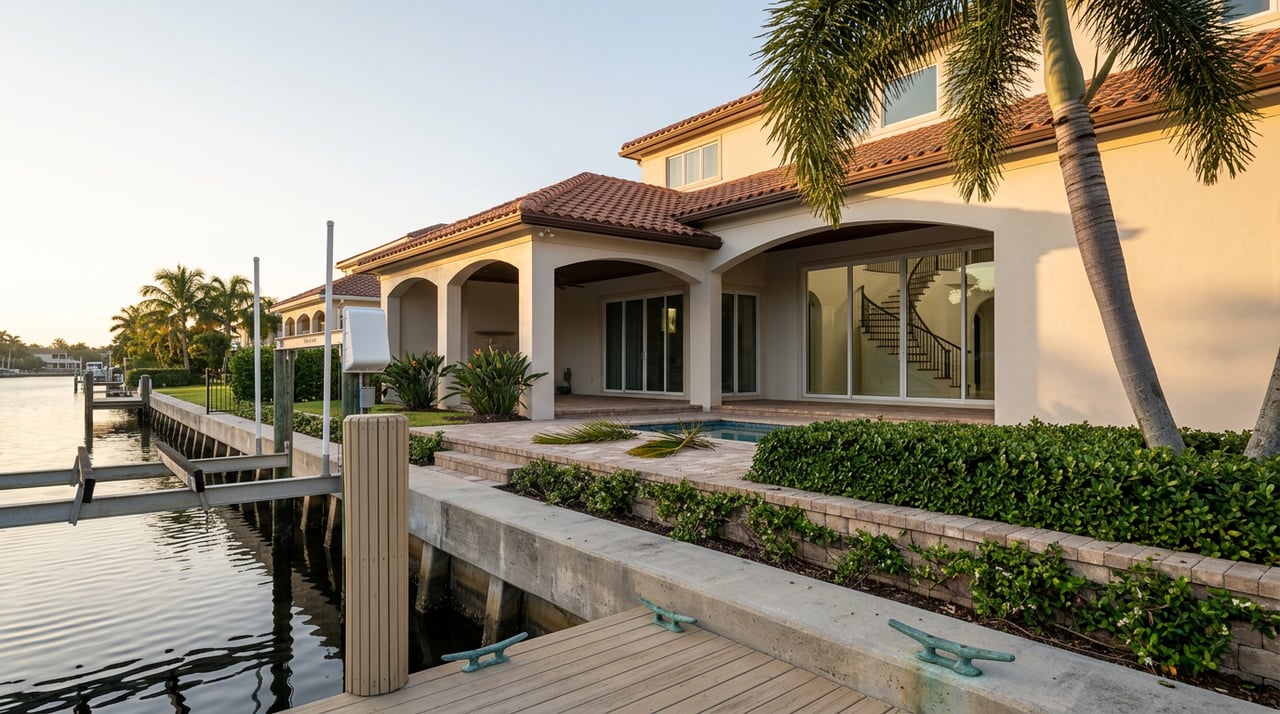
Seawalls and docks in Florida waterfront communities are private property, not shared infrastructure the way roads or clubhouses are. When one fails, the cost lands on whoever owns the lot behind it, and current Florida contractor pricing gives a real sense of scale:
- Seawall repair runs roughly $100 to $250 per linear foot
- Full replacement runs $150 to $600 per linear foot depending on material
- A typical residential replacement lands between $40,000 and $175,000, with most jobs closer to $90,000 to $120,000
Boca Harbour's canal lots commonly run 85 to 130 feet of frontage based on recent listings, which puts a full seawall replacement solidly in the five-figure to low-six-figure range for a single property. That's before factoring in the same neighbor whose failing wall could compromise your side of the canal if left alone.
Boca Raton doesn't let owners handle this quietly, either. The city regulates seawall work under Chapter 22 of its code and Section 7.7 of its Engineering Design Standards Manual, updated in January 2025. That means a permit, a survey of the seawall line, and inspections both before the cap is poured and again at completion. A failing wall isn't a weekend fix. It's a permitted project with a timeline, and in a community with no HOA to coordinate it, that timeline is entirely up to the owner who's paying for it.
Reading the Price Range Instead of the Median
A market snapshot from January 2026 showed six active Boca Harbour listings averaging 153 days on market, with a median list price around $4.05 million and an average of roughly $1,009 per square foot. That's a slow-moving, thin market, which is typical for a small enclave rather than a sign of trouble. It also means buyers here have more room to negotiate than the median price alone suggests.
What the median hides is how differently priced the homes underneath it actually are, and the spread tracks directly with age, lot condition, and which section of the neighborhood you're in:
| Property type | Built | Size | List price |
|---|---|---|---|
| Original ranch home, standard canal lot | 1972 | 2,108 sq ft | $1,240,000 |
| Renovated estate, standard canal lot | 2008 | 4,248 sq ft | $3,695,000 |
| New construction, Boca Harbour Island | 2019 | 7,146 sq ft | $10,450,000 |
That's not three points on one curve. It's three different products. The 1972 ranch is close to a land-value purchase where the seawall's condition is the whole story. The island estate is new enough that infrastructure risk is lower, but it sits under a different HOA than the mainland listings a buyer might be cross-shopping against. Treating the median as a stand-in for "what a Boca Harbour house costs" tells you almost nothing about which of these three situations you're actually walking into.
What to Confirm Before You Write an Offer
Before you get attached to a dock or a view, get specific answers on paper:
- Which section is this property in, mainland or Harbour Island, and which governing body actually applies
- When was the seawall last inspected, and does the seller have permit records for any prior repair
- What's the age and material of the seawall on the two adjacent lots, not just the subject property
- Has the city issued any permits for seawall or dock work on this block in the last five years
- If you're financing, has your lender flagged seawall condition as part of the appraisal
None of these questions show up on a standard listing sheet. All of them affect what you'll actually pay to own the property for the next ten years.
A Few Common Questions
Is Boca Harbour gated? No. It's an open community, which is part of why the residents club exists as a purely voluntary social organization rather than a gate-and-guard operation.
Can I dock a large yacht there? Deep-water lots in Boca Harbour commonly accommodate vessels from around 30 feet up to 100 feet or more, with no fixed bridges standing between the neighborhood and the Intracoastal.
Does the voluntary residents club replace an HOA? No. It funds community events and resources, not infrastructure enforcement. If you want dock or seawall standards enforced across a neighborhood, that's a different kind of community than Boca Harbour's mainland section.
Boca Harbour rewards buyers who do the homework a standard listing search skips. If you're comparing this canal against Bel Marra, Boca Bay Colony, or another East Boca waterfront enclave and want the seawall and permit history pulled before you make an offer, I'll walk it with you.
Schedule a free market consultation with Matt and get the section-by-section detail that decides what a Boca Harbour address actually costs to own.